THE STAGE 32 LOGLINES
Post your loglines. Get and give feedback.

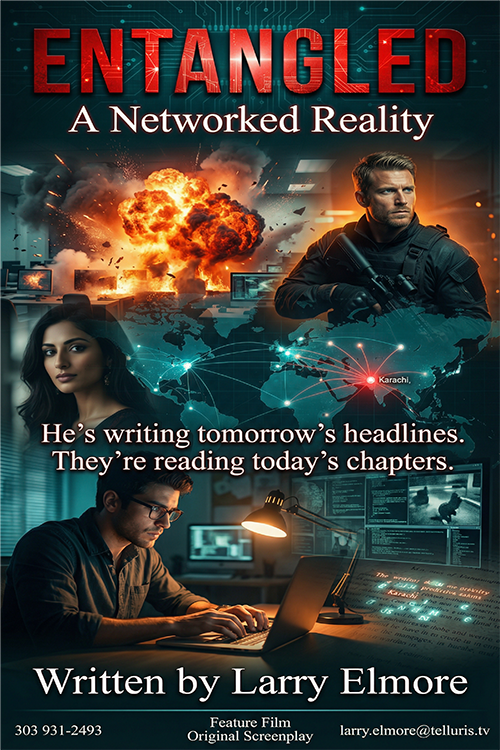
ENTANGLED, A NETWORKED REALITY
By Larry Elmore
He's writing tomorrow's headlines. They're reading today's chapters.
When a successful tech journalist, John Burgess, mysteriously begins writing a novel that predicts real-world terrorist operations and classified intelligence missions days before they happen, a Princeton professor-turned-covert operative and a multi-agency task force race to decode the inexplicable connection—only to discover the writer has been kidnapped by a rogue CIA faction desperate to control his prophetic gift. As the time gap between fiction and reality compresses to zero, the team must outsmart enemies who can read their every move in advance by manipulating the one thing the writer can't control: the dialogue in his own story.
SYNOPSIS:
ENTANGLED is a high-concept action thriller that weaves together two parallel narratives— one unfolding in "present day" reality, the other within the pages of a novel being written in real-time—creating a mind-bending exploration of fate, surveillance, and the blurred boundaries between fiction and truth.
The Dual Narrative Structure: The screenplay opens with John Burgess, a 29-year-old tech journalist and aspiring novelist, waking at 3 AM compelled to write a story he doesn't fully understand. He sends the first chapter to literary agent Robert Sullivan, whose reader Brenda Marks begins evaluating what appears to be a promising spy thriller. What follows is an intricate dance between two realities: John writing chapters of his novel in Denver, and those exact events simultaneously unfolding in the real world.
The Story Within the Story: John's novel centers on Professor Rob Chase, a Princeton computer science expert who has developed revolutionary Internet traffic analysis software capable of identifying terrorist communications by tracking anomalous routing patterns. When his graduate assistant Ryan Tyler discovers suspicious message traffic originating from Karachi, Pakistan, the lab is bombed by Wajhulla terrorists, killing Ryan and a woman believed to be Amira Khan, a guest lecturer and Rob's lover. Devastated and suspicious, Rob investigates Amira's background only to discover she never existed—the real Amira Khan died as a child in Iowa. When NSA agents arrive revealing they funded his research, Rob is recruited into a covert military operation. He's actually Lt. Colonel Rob Chase, a decorated special operations officer who maintains his academic cover. Assembling his elite team—Private Bill Ryder (tech specialist), Sergeant Brett Welker (surveillance expert), and Captain Brigid Callahan (intelligence analyst)—Rob deploys to Karachi to hunt down the terrorists and uncover the truth about Amira. In Pakistan, Rob's team conducts surveillance on the Wajhulla network and discovers that Amira is alive—she's actually Rana Tareen, a deep-cover CIA operative whose encrypted messaging system was being used by someone within the U.S. intelligence community to communicate with terrorists. The investigation reveals a rogue CIA operation led by Herman Rodman, who has been funding the Wajhulla terrorists as part of an unsanctioned scheme to infiltrate larger terrorist networks. When Rob's software threatened to expose the operation, Rodman ordered the bombing.
The Meta-Reality Crisis: As John writes each chapter in Denver, intelligence agencies discover something impossible: his novel is predicting classified operations with uncanny accuracy, typically three to four days before events occur. The NSA's Special Investigations Unit, led by Assistant Director Rick Drummond and analyst Priscilla Reed, places John under 24/7 surveillance, watching him write at his laptop every morning at 3 AM. The temporal gap between John's chapters and real-world events begins compressing— four days becomes three, then two. The intelligence community realizes they're facing an unprecedented security breach, but John has no clearances, no access, and no apparent connection to the classified world he's describing in perfect detail. When Rodman's faction discovers that John's novel is exposing their conspiracy, they kidnap him and hold him at a CIA safe house in Northern Virginia. Rodman believes he can use John's prophetic ability to stay ahead of the task force hunting him—if John keeps writing, Rodman will always know his enemies' next move hours before they make it.
The Ingenious Countermove: Rob realizes the key to defeating an enemy who can read the future: control the dialogue. While John cannot control the expository narrative—the actions people take—he can only write dialogue after hearing it. Rob's team begins conducting all critical planning in complete silence, communicating only through written notes and gestures, denying John (and therefore Rodman) access to their actual plans. The strategy works. When John attempts to write the next chapter, he stalls—unable to complete scenes without dialogue. Frustrated and desperate to communicate, John uses an internet key to connect directly to Brenda Marks, bypassing Rodman's monitoring of the safe house computer. This single act of defiance allows the FBI's Critical Incident Response Group, working with Rob's team, to triangulate John's location.
The Resolution: In a coordinated multi-agency operation, the FBI rescues John while Rana's team raids Rodman's computer dead drop, uncovering the full extent of his illegal operation. Rob confronts Rodman in his CIA office, and FBI Agent Malcolm Sprague arrests him for murder, kidnapping, and crimes against the United States. The final scene John writes describes Rob and Rana's reunion—a passionate kiss in Rodman's office—which the entire task force watches scroll across their screens in real-time at the operations center. The team erupts in applause as John types "The End."
The Epilogue: But the story doesn't end there. Days later, Rob receives a call that John is writing again. The Wajhullanetwork remains active, and Rob's team prepares for their next mission. In a circular narrative twist, the screenplay closes with Brenda Marks receiving a manuscript from novelist Richard Barnes—John Burgess's completed novel, titled Entangled: A Networked Reality—the very story we've been watching unfold. Was it fact, or fiction? Only time will tell.
Themes and Innovation: ENTANGLED explores profound questions about free will, determinism, and the nature of reality in an age of total surveillance. The screenplay's innovative structure creates a unique viewing experience where audiences must constantly question which layer of reality they're witnessing. Is John writing the story, or is the story writing itself through John? The title suggests quantum entanglement—the phenomenon where particles remain connected across vast distances—mirroring how John and the characters in his novel are mysteriously linked across the boundary between fiction and reality. The film combines the intellectual intrigue of Stranger Than Fiction with the high-stakes espionage of the Jason Bourne series, while adding a meta-narrative complexity reminiscent of Adaptation or The Truman Show. It's a thriller that works on multiple levels: as a taut spy adventure, as a meditation on storytelling and authorship, and as a cautionary tale about surveillance technology and government overreach.
At its core, ENTANGLED asks: In a world where everything is monitored, recorded, and predicted, can free will survive? And if someone could write your future, would you want to read it?
 Register / Log In

Rated this logline
Rated this logline